Ask more, ask better
While most tools are equally good or bad at organizing raw Qualitative data, the real potential of GenAI lies in using established analysis frameworks to cull out fresh insights.
GenAI helps Qualitative researchers challenge their thinking about client problems; inspires the way they organize, sieve and present data.
Browse, copy and use this tried-and-tested compilation of Qualitative Data Analysis and reporting prompts, developed to inspire your analysis and report-writing
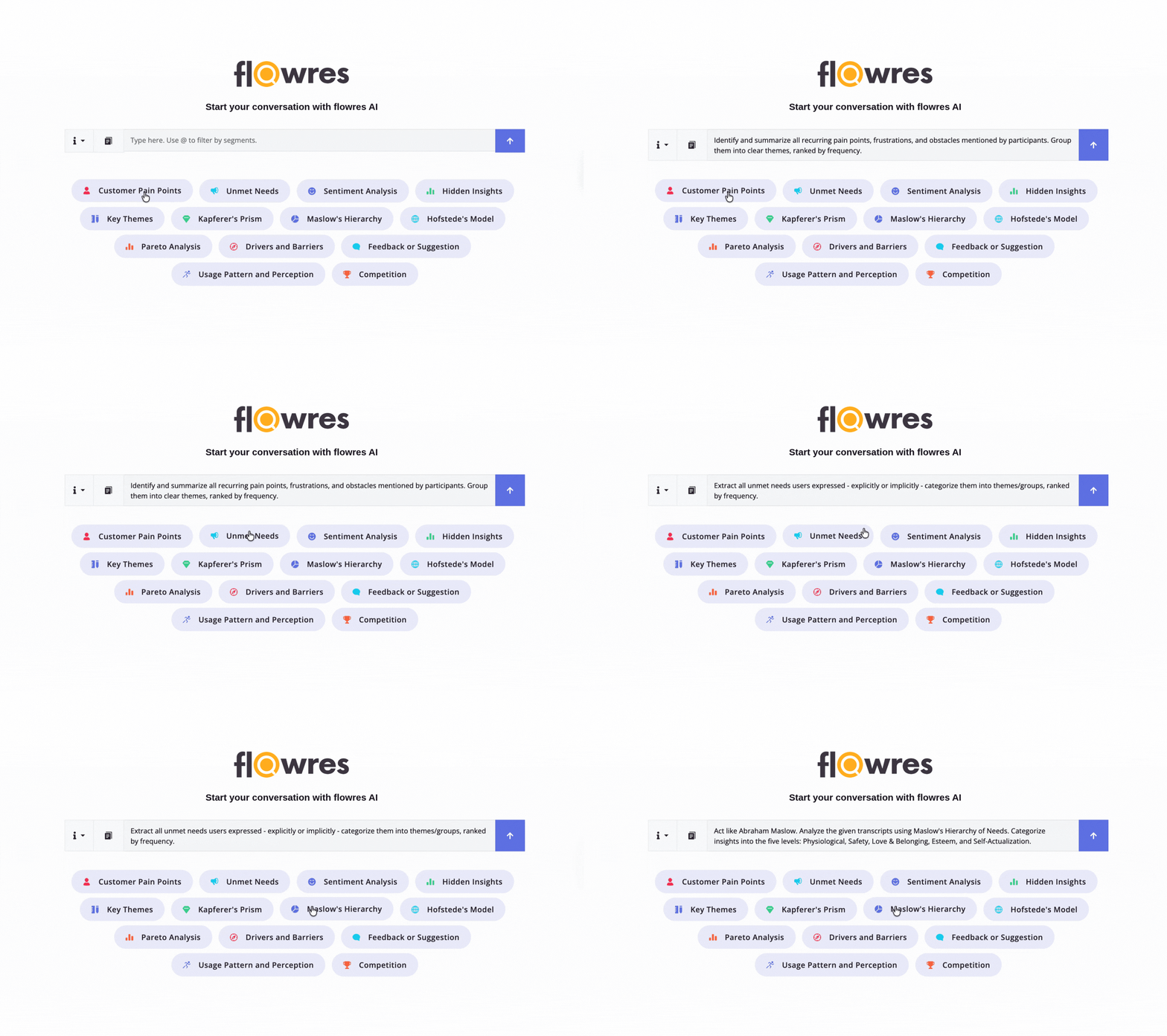
Generic prompts
Usable for various types of mainstream Qualitative Data Analysis
Start with sharing context:
My client on this study is [add client background eg, #3 player in ____ category, present across ___ countries]. Business objective behind conducting this study was to [add Business Objectives here]. And hence the research objective for this study was [add Research Objectives here]. These transcripts are from In-depth interviews, where we covered [add Information Areas here].Purpose: Key themes
Based on the given transcripts, analyse the key themes and patterns that emerge from participant responses. Identify recurring viewpoints, contrasting perspectives, and any underlying motivations.
Summarize the most significant conclusions that can be drawn from these insights, ensuring they are grounded in the data. Provide evidence or verbatim quotes where applicable.
Purpose: Beefing up recommendations
Given the key findings from this qualitative study, what are the most actionable recommendations for [mention specific stakeholder teams: e.g., product team, marketers, CEOs/owners]. Consider the challenges, opportunities, and sentiment expressed in business objectives.
Prioritize recommendations based on feasibility and impact, given the business objectives. Provide justification for each suggestion.
Purpose: Uncovering hidden insights
Review the transcripts and identify any hidden insights or implicit messages that participants may not have stated explicitly, but can be inferred from their responses. What underlying concerns, unmet needs, or emerging trends can be extracted? Provide justification and your thinking behind each of these conclusions. Also tell me – how do these insights shape the broader conclusions of the study?
Purpose: Arriving at segment-specific insights
Compare the qualitative insights emerging from ( Name of the segments e.g., demographics, usership etc).
Identify any variations in opinions and explain their significance.
What conclusions can be drawn from these differences, and how should decision-makers tailor their strategies accordingly?
Purpose: Recommendations to maximize business value
Can you give me 5 specific recommendations that I can give to my client which will help him attract more buyers? The recommendations need to be in line with the tradeoffs and should maximize value for my client; while attracting more buyers.
Purpose: Exploring trade offs
Analyze the qualitative research transcripts to identify key tradeoffs that participants consider when making decisions related to [Study topic). Outline the primary factors influencing these tradeoffs, highlighting competing priorities, perceived benefits, and associated risks. Where applicable, compare how different participant segments weigh these factors differently. Provide a structured summary of these tradeoffs and recommend how decision-makers can optimize solutions based on participant preferences.
Prompts to apply Analysis Frameworks
Use established frameworks to unlock deeper, structured insights from your data
Kapferer's (Brand Equity)
Act like Jean-Noël Kapferer. Analyze the given transcripts using Kapferer's Brand Identity Prism for Brand 'A'.
Categorize insights into 6 facets: Physique, Personality, Culture, Relationship, Reflection and Self-Image.
Identify key themes, emotional tones, and sentiment variations. Provide a structured report, with verbatim examples supporting each category. Compare insights across Brand 'A' loyalists vs Competition loyalists.
Ensure traceability of insights to original responses and format the output with bullet points, tables, and structured categories.
Hofstede's (Cultural dimensions)
These transcripts are from In-depth interviews conducted for a study covering attitudes towards home ownership, purchase journey, home buying preferences and perception of Real Estate brands.
Act like Geert Hofstede and analyse these transcripts using Hofstede's Cultural Dimensions Model.
Categorize insights into the 6 dimensions: Power Distance, Individualism vs. Collectivism, Masculinity vs. Femininity, Uncertainty Avoidance, Long-Term vs. Short-Term Orientation, and Indulgence vs. Restraint. Compare insights across Males and Female respondents.
Ensure traceability of insights to original responses and format the output with bullet points, tables, and structured categories.
Pareto principle (Driver analysis)
Analyze these qualitative research transcripts to conduct a Pareto analysis. Identify the most critical factors driving specific outcomes e.g., customer satisfaction, product adoption, service issues, decision making.
Categorize and quantify recurring themes based on frequency and impact, following the 80/20 principle, where approximately 20% of the factors contribute to 80% of the observed effects.
Provide a ranked list of these key drivers and explain their relative importance. Offer strategic recommendations on which high-impact areas should be prioritized for maximum effectiveness.
Give a supporting quotes wherever possible.
Maslow's (Hierarchy of Needs)
Act like Abraham Maslow. These transcripts are from In-depth interviews conducted for a Study covering attitudes towards home ownership, home purchase journey, home buying preferences and perception of Real Estate brands.
Analyze these transcripts using Maslow's Hierarchy of Needs. Categorize insights into 5 levels: Physiological, Safety, Love & Belonging, Esteem and Self-Actualization. Compare insights between Male and Female segments and highlight differences in their needs, wherever applicable. Ensure traceability of insights to original responses and format the output with bullet points, tables and structural categories.
Eisenhower matrix (Productivity)
Initial prompt:
These transcripts are from In-depth interviews conducted for a study covering attitudes towards home ownership, home purchase journey, home buying preferences and perception of Real Estate brands.Basis these transcripts, synthesize insights, identify trends and provide clear, practical recommendations.
Follow-up:
Act like a Priority Management Expert well-versed in the Eisenhower/Covey decision matrix. For all recommendations that you came up with, construct a detailed Eisenhower Box, categorizing tasks/challenges into 4 quadrants: urgent and important, not urgent but important, urgent but not important, and neither urgent nor important. Dive into the strategic implications of each quadrant & advise on the best course of action for each.